Monday, May 17, 2010

The One that Says it all.

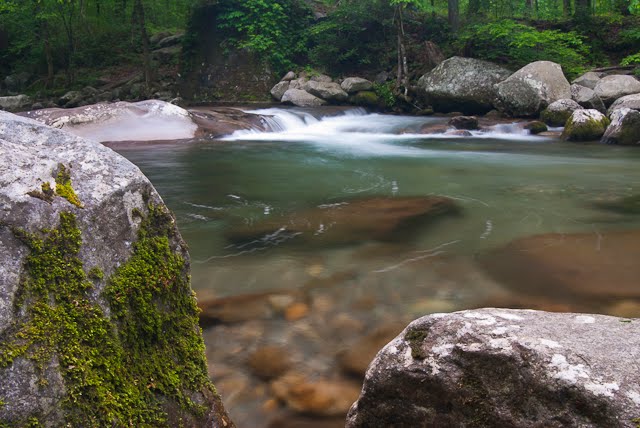
Anytime that you take a series of photographs there is one that stands out above all the rest.  This is the one for me.  It is a panoramic taken the first morning I went to the mountains and shows the majesty of creation.  It is quiet and peaceful with only the sound of the wind in the trees and the birds starting their morning routine.  No, it would not win many awards but for me it says it all. 

Be sure to click on the image to see the entire Panoramic.  This print is available for sale at eldridgestudios.com for $75.00.  

Thursday, May 13, 2010

Day four in the Smoky Mountains

The three photographs below are from the forth and final day in the Great Smoky Mountain. There will be more photographs to follow as well as photography tips and "Understanding Exposure Part 3 of 3".
Prints available for sale at eldridgestudios.com starting at $50.00


Wednesday, May 12, 2010

Day three in the Smoky Mountains

The three photographs below are from day three in the Great Smoky Mountain. There will be more to follow as well as photography tips and Understanding Exposure Part 3 of 3.


Prints available for sale at eldridgestudios.com starting at $50.00


Sunday, May 9, 2010

Understanding Exposure (Part 2 of 3)

Aperture

Aperture is the control of how wide the opening is in the lens of the camera. It also affects how much light is hitting the sensor. A simple way to think of Aperture is a faucet of running water. If the faucet is wide open then you get a lot of water. If it is almost closed then it is just a trickle. This is the same for light coming through the camera lens. One of the main purposes of the aperture is to control depth of field (see previous blog post on Depth of Field). The size of the opening is recorded in what is call an f-stop. Now, the math is a bit different for the Aperture than the shutter speed but the principle is the same. Each step represents the doubling or halving of the amount of light hitting the sensor. The following is a general list of the most common apertures: 2.8, 4, 5.6, 8, 11, 16, 22. The smaller the number the larger the opening in the camera and thus the shallower depth of field. When you hear the term "fast lens" the aperture is what they are referring too. Why? Well, if you have a wide open lens (say 2.8) then the amount of time the shutter has to be open to make a proper exposure is shorter than it would be with a smaller aperture (larger number). This means that if you are taking photos in lowlight you can open up your lens and raise your shutter speed. When you are photographing wildlife in the early morning you need a fast lens. If you are photographing a wedding inside a dimly lit church when no flash photograph is allowed then you need a really fast lens.  The first image below shows a very small aperture (high f-stop number).  The second shows a wide open aperature (small f-stop number).  You can clearly see the differance in depth of field.

Image 1

Exposure:  0.7sec at f/16
Image 2

Exposure: 1/25 sec at f/3.2

Thursday, May 6, 2010

Day two in the Smoky Mountains

The three photographs below are from day two in the Great Smoky Mountain.  There will be more to follow as well as photography tips and Understanding Exposure Part 2 of 3.


Prints available for sale at eldridgestudios.com starting at $50.00


Wednesday, May 5, 2010

Understanding Exposure (Part 1 of 3)

There are three main factors to consider when you look at exposure.  Shutter Speed, Apeture, and ISO.  Below is Part 1 of 3 on understanding exposure.  I will likely do a wrap up after part three to include the camera meter and histogram so stay tuned.

Shutter speed
The shutter speed of your camera is the measure of how long the shutter remains open to expose the sensor. Any motion that occurs while the shutter is open will show on the image. (the faster the shutter speed the more likely you are to freeze the movement). Shutter speeds are based on the doubling or halving of seconds. The following is a general list of the most common shutter speeds from long to short: 1/15, 1/30, 1/60, 1/125, 1/250, 1/500, 1/1000, 1/2000, 1/4000, 1/8000. As you can imagine the 1/8000 of a second shutter speed would just about freeze any movement.  The shutter speed for Image 1 below is 1/20th of a second.  This by no means freezes the movement but you can see that much of the movement was stopped.  The shutter speed for Image 2 was 1.1 seconds allowing the movement to blur the image.  Really it depends on what type of image you are going for.  If you have any questions please feel free to contact me.

Image 1

Shutter Speed: 1/20 sec

Image 2


Shutter Speed: 1.1 sec

Tuesday, May 4, 2010

Just a few shots from day one in the mountains.

More to follow soon!


Prints available for sale at eldridgestudios.com starting at $50.00